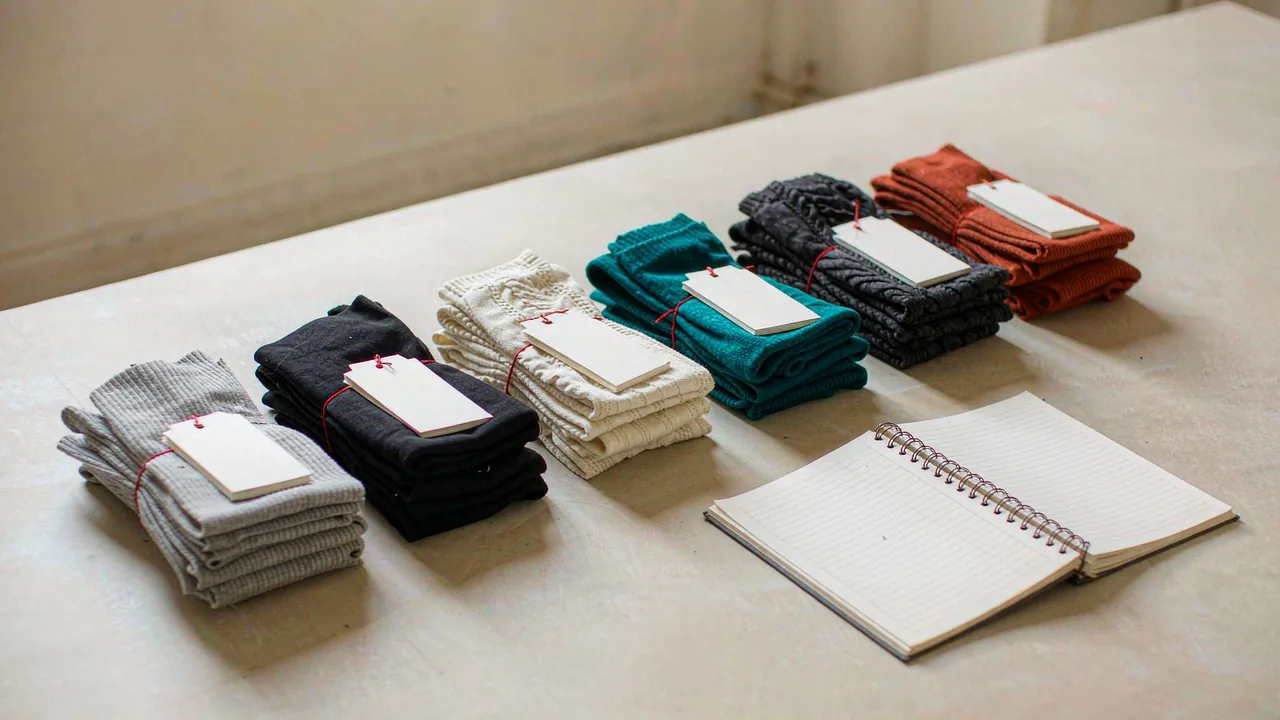
01 · What the MOQ question asks
What is a minimum order quantity actually answering?
Buyers usually meet the minimum order quantity as a wall: a number a supplier publishes, below which the conversation seems to close. Read as a rule, it looks arbitrary. Read as a price signal, it explains itself.
A MOQ is the smallest order at which the fixed work behind a style can be spread without the garment carrying more setup than product. It is not a statement about how much a factory wants to sell, and it is not a negotiating position. It is the point where the arithmetic of one style stops working.
- What does the minimum cover?
- Usually per style and per colourway, not per order. Three styles at 150 pieces each is not the same as one style at 450, even though the totals match.
- Why does it move by style?
- Because the fixed work is not constant. A plain single-process knit carries less of it than a multi-panel, multi-process style.
- Can it be negotiated down?
- Sometimes the quantity can be shaped — fewer colours, a simpler construction, a stock fabric — rather than simply lowered.
HACOLD works to MOQ 200–500 pcs per style, and where a specific style sits inside that band is confirmed against the specification. What follows is the reasoning behind any factory's minimum, so the number can be planned around rather than argued with.
02 · Where the minimum comes from
Why minimums exist: the work that happens once.
Part of the cost of any style is incurred before the first production piece is sewn. Pattern development and grading, sample rounds, marker making, print or embroidery setup, trim sourcing and the pre-production checks that stop a line running into a defect. That work is roughly the same whether the order is 200 pieces or 2,000.
Spread across a large order, the fixed work is a small part of each unit. Spread across a small one, it dominates. Below some quantity, the buyer is paying mostly for setup, and the resulting per-unit figure stops being a fair representation of either the garment or the factory.
Minimums also protect the buyer, though that is rarely how they are heard. An order run at a quantity the process cannot support produces the worst version of every failure: rushed setup, unproven markers, and a defect rate discovered after the goods are made.
Garment production is also labour-intensive in ways that official analysis treats as structural rather than incidental.[2] Skilled hours sit inside every stage, and a very small order buys very few efficient hours while still consuming all of the setup ones.
03 · Why a band, not a number
Why the same factory quotes a band instead of a figure.
A single published minimum would be easy to compare and mostly meaningless. The quantity a style genuinely needs depends on inputs the buyer controls, which is why serious suppliers state a range and place each style inside it after review.
- Fabric. A stock fabric available in small lots supports a lower minimum than a mill article that must be dyed to order against a mill minimum.
- Colourway count. Each colourway multiplies cutting, labelling and handling. Five colours at 100 pieces is a harder order than one colour at 500.
- Construction. More panels, more operations and more applied processes each add setup and handling that has to be recovered.
- Decoration. Screen setup, embroidery digitising and heat-transfer tooling are fixed costs that only make sense above a quantity.
- Trims. Custom labels, hardware and packaging components carry their own minimums from their own suppliers.
Raw-material and commodity movement sits underneath all of this, because the price and availability of the inputs behind a style change before any buyer arrives.[1] A minimum quoted from a material that has since moved is a number that needs re-confirming.
04 · What sits inside the minimum
What the minimum actually covers — and what it does not.
The most common MOQ dispute is definitional. The buyer assumed one thing; the supplier meant another. Neither was dishonest; nobody defined the unit.
- Per style
- The usual basis. A style is a body, in one construction, offered across size and colour ratios.
- Per colourway
- Many factories state the minimum per colour as well as per style, because each colourway re-runs cutting and handling.
- Per delivery
- A split delivery can fall under the minimum even when the total does not, because the second shipment re-runs setup.
- Not the sample
- Sampling is priced separately from production. A sample quantity never counts toward a production minimum.
Ask the question directly before quoting: is the minimum per style, per colourway, or per order — and does a repeat order of the same style carry the same minimum as the first?
05 · Planning the split
Styles, colours and size ratios change the answer more than the total does.
Buyers tend to negotiate the total and ignore the split. In practice the split moves the production outcome more than the headline number.
- Many styles, low each. Six styles at 120 pieces each consume six sets of setup. The total looks healthy; the fixed cost is multiplied.
- Few styles, deep. Two styles at 400 pieces each run efficiently and often land at a better per-unit figure than the six-style plan.
- Colour ratio. A 60/25/15 split across three colours is a normal order. Nine colours at near-equal split is nine small orders wearing one label.
- Size ratio. Sizes share a marker only when the ratio lets the cutter nest efficiently. An extreme ratio wastes fabric and shows up in cost.
A range that is planned around the split, rather than negotiated at the total, usually finds the minimum is not the constraint it first appeared to be.
06 · Below the minimum
Ordering below the minimum: what actually changes.
Sometimes a small quantity is the right commercial decision — a capsule test, a restock of a proven seller, a limited colourway. The options below a stated minimum are real, but each one trades something, and the trade should be named.
- Simplify the style. Fewer panels, fewer processes, a stock fabric. The fixed work shrinks, so a lower quantity can work.
- Reduce colourways. One colour instead of four removes repeated setup and handling.
- Accept a stock material. A dyed-to-order fabric carries a mill minimum; a stock colour does not.
- Pay the small-order rate. The order runs, and the unit price carries the setup honestly. This is a legitimate choice when the information the order buys is worth more than the premium.
- Wait, or combine. Merge the test into a planned restock, or group styles so the total reaches the minimum.
What should raise a flag is a supplier who accepts any quantity at a normal price with no change to the plan. Either the setup is not really happening, or the difference will surface later as substitution.
07 · Planning a range
Planning a range around the minimum, instead of against it.
A first production run usually teaches the same lesson: the range was planned as designs first and quantities second. Reversing the order makes the minimum a design input rather than a late obstacle.
- Start from the body, not the story. Group styles that share a fabric, a construction and a colour palette so setup is shared.
- Depth before breadth. Fewer styles with honest depth produce better samples, better markers and a cleaner first delivery than a wide, shallow range.
- Keep one proven style in the plan. A restock candidate gives the order a floor while the untested styles find their level.
- Decide the colour ratio with the cutter in mind. Ratios that nest well waste less fabric and price better.
None of this constrains the design. It sequences it: which decisions carry cost, and which of those should be settled before the range is drawn.
08 · Comparing suppliers
Comparing MOQs between suppliers: what the number does and does not tell you.
A lower stated minimum is not a more flexible factory. It can mean a simpler process, a stock-fabric business, or a willingness to run orders that later produce the problems described above.
- Basis
- Per style, per colourway or per order. Without the basis, two minimums cannot be compared at all.
- What moves it
- Ask what would raise or lower the number for your specific style. A supplier who can answer precisely understands their own process.
- Repeat behaviour
- Whether a restock of the same style carries the same minimum, or benefits from the setup already done.
- Below-minimum policy
- What the options actually are, and what each one costs. Vagueness here predicts vagueness later.
The manufacturer selection guide covers the wider evaluation; the minimum is one input to it, not the decision itself.
09 · Confirming your number
Confirm the number for your style, not the published one.
A published band is a planning tool. The number that matters for a budget is the one that comes back against a specific specification, with the fabric, colourway count, construction and decoration stated.
- Send the quantity context, not just the total: per style, per colourway and the size ratio you expect.
- Name the fixed elements: custom labels, hardware, decoration setup, packaging components.
- Ask what would move the number for this style in either direction, and why.
- Keep sample and production quantities separate in the budget from the start.
Quantity is also a cost input: the position a style takes inside a band shows up directly in the unit price. The cost drivers guide covers that side. When the quantity is settled and the question becomes which commercial terms are fixed against it, continue to sourcing and commercial terms.