01 · Checklist scope
Use quality control to make decisions.
This checklist helps a buyer define what must be checked, which reference controls the decision, what evidence should be recorded and who can release or reject the result. It applies the same way whether the order is described as a garment, an apparel product or a clothing style. Adapt it to the product, material, destination market, risk and agreed inspection scope.
It is a buyer-side QC checklist, not a universal specification, inspection standard or legal checklist. It does not state that HACOLD performs a particular AQL plan, laboratory test, certification or inspection sequence. Those operating claims require separate evidence and project agreement.
Examples include sample approval, material release, production start, in-process correction, final shipment release or repeat-order change review. The same observation can lead to a different decision at a different stage.
02 · Before inspection
Lock the approval set and inspection scope.
The inspector needs a controlled reference set. If the buyer and supplier are using different versions, a detailed inspection can still reach the wrong conclusion.
Controlled product references
- Current specification or tech-pack version and issue date.
- Approved sample identity, photos and any sealed reference.
- Approved bill of materials, trim card and colour standard.
- Approved artwork, labels, placement and packaging files.
Inspection scope
- Stage, location, lot definition and available quantity.
- Inspection type and which product areas are included.
- Sampling method or 100% check, with the decision owner.
- Required photos, measurements, counts and records.
Acceptance logic
- Defect definitions and critical/major/minor classification.
- Product-specific tolerances and approved exceptions.
- Pass, conditional release, rework, hold and reject rules.
- Authority required for any concession or deviation.
Information readiness
- Destination-market labelling and compliance inputs.
- Open changes or approvals that affect interpretation.
- Previous issue history and containment to recheck.
- Report recipients, timing and escalation channel.
03 · Specifications and versions
Confirm that the inspected product matches the current instruction.
Begin with identity: style, colour, size, order, production lot and reference version. Then check whether the build matches the approved construction, component, placement and finishing instructions.
- Style and variant identifiers are consistent across garment, label, polybag, carton and documents.
- The specification, bill of materials and artwork versions are the latest approved issues.
- Approved changes are recorded with date, owner, affected quantity and disposition.
- No informal message or marked-up image silently overrides a controlled specification.
- Unknown or conflicting requirements are placed on hold rather than interpreted as acceptance.
04 · Materials and trims
Check identity, appearance, performance inputs and traceability.
Material review should cover the main fabric, lining, interlining, elastic, thread, fasteners, decoration, labels and packaging components relevant to the product. The acceptance criteria must come from approved product requirements or qualified testing—not from a generic “good quality” statement.
- Identity
- Supplier/article reference, composition input, colour, finish, width or weight where specified, and the lot used for the inspected product.
- Visual match
- Approved colour/light condition, shade continuity, surface, hand-feel reference, print/embroidery appearance and visible contamination.
- Functional suitability
- Stretch/recovery, closure function, attachment security or other product-specific attributes defined in the brief.
- Evidence
- Approved swatches, incoming records, test reports or declarations required for the project, with source, scope and date.
- Exception handling
- Affected quantity, isolation, buyer impact, proposed substitute or rework and the person authorized to decide.
05 · Construction and workmanship
Inspect the product where use, durability and appearance can fail.
Quality control has to follow the garment construction, not a generic list copied across every style. Review the operations that carry stress, determine fit, shape visible alignment or connect components.
- Seam type, stitch formation, stitch density and seam allowance where specified.
- Skipped, broken, loose or unsecured stitching; open seams; needle damage; puckering or roping.
- Reinforcement at stress points, pocket openings, fasteners, straps and attachment points.
- Symmetry, matching, panel orientation, stripe/check alignment or print placement where applicable.
- Button, snap, zipper, hook, drawcord and other closure operation and security.
- Thread trimming, stains, oil, marks, holes, foreign matter, sharp points or product-specific hazards.
- Pressing, shaping and finishing consistent with the approved appearance.
Define each defect in observable language. “Bad sewing” is hard to decide consistently; “open side seam longer than the agreed limit” can be classified, recorded and escalated.
06 · Measurements and fit
Specify the method before interpreting the number.
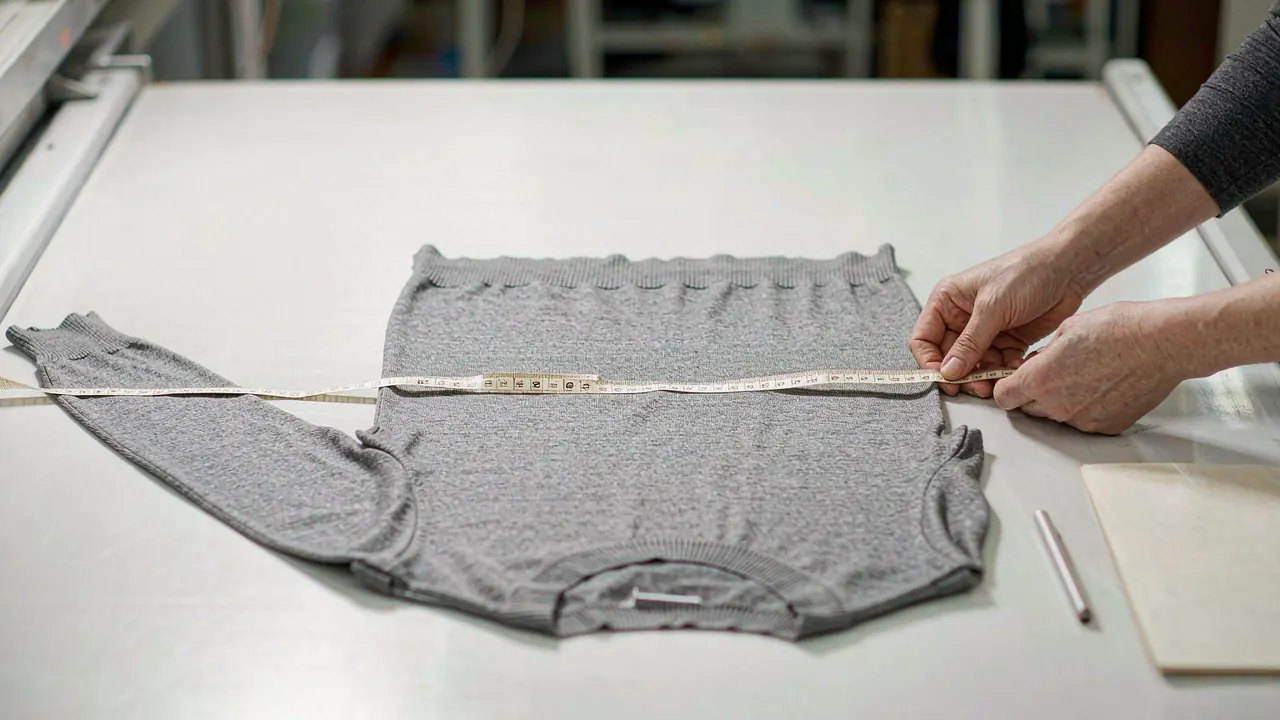
Measurement results depend on how the garment is conditioned, positioned and measured. The buyer should control the point of measure, diagram, garment state, tool, unit, tolerance and sample distribution across sizes and colours.
- Confirm the correct measurement chart and approved sample reference.
- Define whether the garment is relaxed, stretched, fastened, laid flat or otherwise conditioned.
- Use the stated point-of-measure diagram and record actual values—not only pass/fail.
- Review repeated direction or pattern in deviations, not only isolated measurements.
- Separate measurement conformity from a fit decision that requires a wearer, form or specialist review.
A garment can sit inside a tolerance table and still fail the intended fit, balance or appearance. Record who owns fit approval and which sample establishes that decision.
Measurement follow-up
Record dimensional change without inventing a shrinkage limit.
When a brief calls for wash or dimensional-change review, ask the technical reviewer to agree the preparation, measuring points, care procedure, repeats and acceptance criteria. A generic shrinkage percentage cannot replace the product-specific agreement.

- Before and after
- Identify the same sample, size, point of measure, unit and method. Retain both measured values and the procedure used between them; do not compare different garments as if they were a paired result.
- Separate directions
- Record length and width findings separately, with any change to seams, rib, twist or appearance. One average can conceal a problem at a fit-sensitive point.
- Decision and closure
- Compare against the agreed criteria. Record an open review, accepted result or required correction with its owner and supporting evidence. Neither this checklist nor a supplier's general statement proves a HACOLD test result.
Carry an accepted change into the current specification and the sample approval record. Reconfirm the review scope if the material or construction changes on a reorder.
07 · Appearance and colour
Define the viewing condition and comparison reference.
Appearance decisions can change with lighting, distance, garment preparation and the approved standard. For colour, print, embroidery, wash or finish, state the reference and viewing method appropriate to the product.
- Overall silhouette, balance, drape and consistency with the approved sample.
- Colour/shade variation within the garment, within a set and across the inspected lot.
- Print, embroidery, wash, embellishment or finish position, scale, clarity and damage.
- Panel matching, nap/direction, visible seam appearance and left/right symmetry.
- Cleanliness, odour where relevant, pressing, presentation and permanent marks.
08 · Labels and packaging
Validate content, placement and market readiness as separate checks.
Label accuracy is not only a visual matter. Destination rules can affect fibre content, care information, responsible-business identity and other product disclosures. UK guidance, for example, addresses fibre-content labelling responsibilities, while Australian and U.S. authorities publish distinct care-labelling requirements.[4][3][5]
ISO 3758 establishes an international system of textile-care symbols, but national requirements and symbol-use rights still need market-specific confirmation.[2]
- Main, size, composition, care, country-of-origin and tracking labels as required by the approved brief and destination.
- Text, symbols, translation, font legibility, sequence, placement, orientation and attachment.
- Hangtags, stickers, barcode/SKU, price or compliance marks matched to the correct variant.
- Fold, presentation, protective material, polybag warnings where applicable, assortment and carton markings.
- Carton quantity, dimensions/weight where required, sealing and shipping-document consistency.
09 · Inspection sampling
Choose a sampling plan; do not infer one from the word “AQL.”
ISO 28590 introduces the ISO 2859 family of acceptance-sampling systems and notes that the appropriate inspection system depends on the situation.[1] A buyer should not copy one number into every order and assume the decision is controlled.
If acceptance sampling is used, a qualified quality owner should define the lot, sample plan, inspection level, defect classification, acceptance quality limits where applicable, switching rules, treatment of critical issues and the action after failure. Some risks may require 100% checking, testing, process controls or another approach rather than attribute sampling.
This resource does not prescribe an AQL, inspection level or sample size and does not claim HACOLD follows ISO 2859. Those details require a product-specific plan and verified operating evidence.
10 · Nonconformity decision
Record the issue, containment and authority to decide.
A useful report identifies what was found and what happens next. It should not allow a supplier, inspector or buyer to silently redefine an acceptance criterion after seeing the result.
- Observation
- Product/lot, location, defect description, count, photos, measurements and the requirement or reference used.
- Containment
- What quantity or process is isolated, what remains at risk and which additional check is required.
- Proposed action
- Rework, replace, sort, accept by concession, hold, reject or investigate—with the effect on product and plan stated.
- Decision owner
- The named function authorized to approve a concession, release the lot or require correction.
- Closure evidence
- Reinspection, corrected record, updated instruction, root-cause/corrective action where appropriate, and repeat-order carry-forward.
When a finding turns into a claim after delivery rather than a correction inside production, the sequence and the evidence each side needs are set out in how a quality claim is assessed and resolved.
Working record
A garment inspection record you can adapt.
Use one row per finding. Keep the observation separate from the release decision so another person can follow what was checked and why the lot was held or released.
- Identify
- Style / colour / size / lot / inspection stage / date / inspector.
- Compare
- Approved specification version / sample reference / check location / agreed acceptance criterion.
- Record
- Observed result / count or measurement / photo reference / affected quantity / limitation of the check.
- Resolve
- Containment / proposed correction / decision owner / due date / recheck evidence / final disposition.
Record the style and lot, mark the seam location in a photo, compare it with the approved construction, and place the affected quantity on hold for a named decision owner. Close the entry only after the agreed correction and recheck. This is a writing example, not a HACOLD inspection result or a universal rejection rule.
Start with the inspection-record sheets in the buyer toolkit. For measurement references, use the tech-pack preparation guide; agree the actual checkpoints through the quality-control review.
11 · Release record
Close with a decision someone else can reconstruct.
- Product, order, lot, quantity and inspection date/location.
- Reference set and versions used.
- Inspection scope, method and limitations.
- Findings, evidence and unresolved deviations.
- Decision: release, conditional release, rework/reinspect, hold or reject.
- Decision owner, date, required follow-up and records to carry forward.
For the operating-model question—how criteria, checkpoints and evidence should be managed with a supplier—continue to the quality-control capability framework.